
CHROMAesthesiae New York, NY 2010
CHROMAesthesiae explores how saturated color gradients can be spatialized through geometry and controlled viewing conditions. Using repetition, alignment, and oblique perspective, the installation tests how variation can be temporarily collapsed—and then reintroduced—through movement and perception.
Installed in a gallery in Williamsburg, the work consists of ten funnel-shaped forms, each varying in scale and carrying a distinct chromatic transition. Every gradient begins in magenta and moves toward a different vivid hue, producing a family of related yet differentiated color fields.
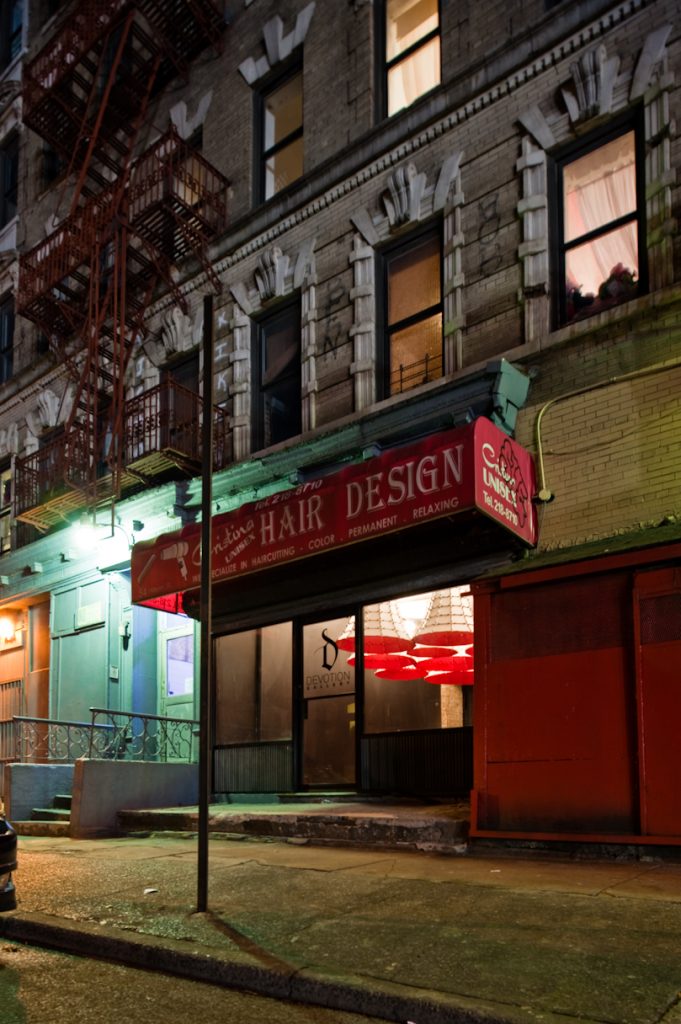
From the street, the funnels visually align, reading as a nearly uniform field of color. This apparent sameness is a product of oblique viewing. As visitors enter the gallery and shift their position, the illusion breaks down: individual gradients emerge, unfold, and separate, revealing their full range through motion alone.
The installation relies on a single formal strategy repeated with variation. Rather than layering multiple systems, complexity is generated through modularity and accumulation, allowing perception itself to activate the work. Color is revealed gradually, not through animation or lighting, but through proximity, angle, and movement.
Each funnel is formed as a catenoid, a geometry that provides structural stability as a thin surface. This efficiency allows the forms to be fabricated from traditional two-dimensional materials—high-gloss printing paper, acrylic, and binder clips—while achieving volumetric presence. Lightweight, precise, and materially direct, the installation transforms gradients into spatial events that are discovered rather than displayed.